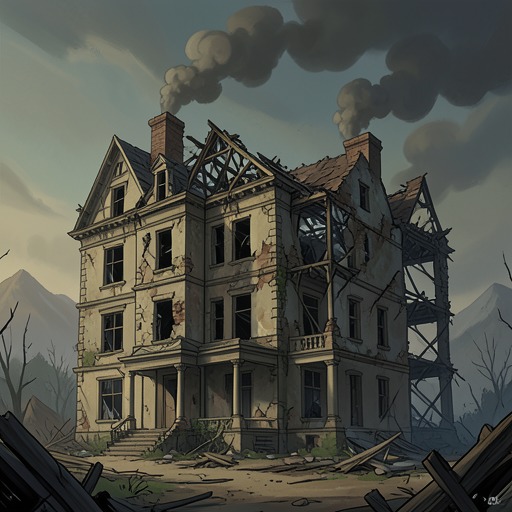
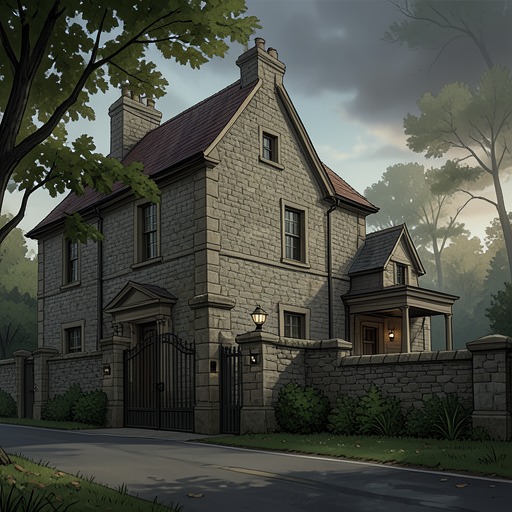
The home as a secluded castle
We Have Always Lived in the CastleThe home as a secluded castle is more than a metaphor for the Blackwood house’s isolation: it names a way of organizing space that turns privacy into protection and exclusion into identity. The house and its grounds shelter Mary Katherine Blackwood and Constance Blackwood from a hostile outside world, but their defensive enclosure also carries the family’s inherited class distinctions. As the sisters’ world contracts, the home becomes at once a refuge, a contested boundary, and a model of their self-contained life.
Boundaries and the family estate
The division between inside and outside was deliberately built into the property. Before the route was closed, people from the Village used the path through the estate as a shortcut to the highway and the bus stop, saving roughly a quarter of a mile. Mary Katherine Blackwood recalls that her mother disliked people walking past the front door. Her father responded by closing the path, locking its gates, and fencing the property from the highway to the creek. The family also maintained a separate main drive for invited visitors, making access a matter of permission and status rather than convenience.
The signs and locks gave this separation a visible form. At the gate, a simple padlock was backed by a no-trespassing notice; there was another locked gate at the far end of the path. Mary Katherine Blackwood understands the warning as more than a practical obstacle: once she has passed through and tested the lock, she feels safe. The boundary works partly through physical barriers and partly through a belief that outsiders have no right to cross it. The family’s private domain thus resembles a castle not because it is impregnable, but because its rules define who belongs within it.
That distinction is already present in Mary Katherine Blackwood’s childhood imagination. She pictures the driveway and path as a crossroads before the front door: the wealthy, properly dressed visitors move up the drive, while Village residents make their way along the path in a manner she imagines as servile. From her dark bedroom, she repeatedly reassures herself that they cannot get in. The image reveals how protection and social superiority reinforce one another. The house excludes intruders, but the child’s fantasy also sorts people into those who supposedly belong and those who must remain outside.
A private geography within the house
The house’s arrangement sustains the sisters’ seclusion even when its exterior faces the highway and the Village. After returning from an errand, Mary Katherine Blackwood locks the front door; the sisters do not expect to use it again until afternoon. Most of their shared life takes place at the back, in the kitchen, the back bedrooms, and the warm room where Julian Blackwood lives. Beyond the rear of the house are Constance Blackwood’s chestnut tree, lawn, flowers, vegetable garden, and, farther off, trees shading the creek. From the lawn, the sisters cannot be seen.
This contrast between the stern front and sheltered rear gives the estate an inward-facing character. The front presents a guarded face to the road, while the back opens onto a landscape the sisters use as an extension of home. The grounds are not simply empty space around a building: their garden paths, trees, and familiar turns provide a private world that Mary Katherine Blackwood knows by where things grow and where they offer refuge. Constance Blackwood tends the flowers and vegetables and cares for food with particular attention; domestic routines make the hidden rear spaces habitable as well as secluded. The home’s security is therefore maintained through care and repeated use, not only through locks.
The house under pressure
The boundaries do not prevent unwanted visitors from trying to gain access. Callers arrive to see Constance Blackwood, sometimes at the door, sometimes by telephone or letter. Some leave when no one answers; others circle the house, try its doors, tap at its windows, and insist that they have a right to see her. Their behavior extends beyond seeking an audience: visitors drive up to the steps, picnic on the lawn, take photographs, let dogs into the garden, and write their names on the walls and front door. The estate’s privacy is repeatedly treated by outsiders as an attraction or an entitlement.
Mary Katherine Blackwood experiences these approaches from behind the house’s defenses. The windows and side door are locked, the upstairs shades are drawn, and she knows that even a slight movement behind the dining-room curtains may alert someone outside. She avoids looking through the narrow glass panels because the visitors watch for signs of life. The blank exterior and the unseen occupants reverse the usual relation between house and visitor: the callers search for evidence that the home will answer, while the sisters preserve safety by withholding any response.
The threat also takes an internal form when Charles Blackwood’s presence unsettles the sisters’ established world. Mary Katherine Blackwood first scatters soil and leaves in his bed and then starts a fire; the critical account reads these actions as attempts to confront the danger of the household’s being invaded. The arrival of firemen, with their entry into the house, makes the breach of the threshold another source of danger and confusion. The episode exposes the cost of treating the home as a stronghold: defending its boundaries can itself transform the place the sisters mean to protect.
Enclosure, class, and stasis
The home’s castle-like quality remains morally and socially complicated. The Blackwoods are conscious of their snobbery toward the Village, while the persecution they endure can strengthen their sense of being set apart. In this design, injury and exclusion may be experienced not only as suffering but also as confirmation of a distinct identity. The sisters’ withdrawal can therefore resemble a victory over conformity even as it leaves them more dependent on the enclosed world they have made.
The ending sharpens that ambiguity. After the Village’s cruelty, residents begin leaving cooked meals and baked goods at the castle-like home’s doorstep. The offerings echo Mary Katherine Blackwood’s earlier imaginative scene in the summerhouse, where she pictures her murdered parents gathered at the family table and indulging her. The later gifts, unlike that imagined feast, are real. They suggest repentance and a changed relation between the sisters and those who once pursued them, but they do not dissolve the enclosure: the food is placed at the threshold, preserving distance even as it supplies the household.
The critical reading describes this change as the world placing a crown on Mary Katherine Blackwood’s head, while calling the resulting realm an empire of stasis. The image captures the double effect of the castle. The home becomes more self-possessed as threatening elements are driven away, and its apparent triumph depends on remaining closed to ordinary social change. Its significance is not exhausted by a single psychological explanation: the castle gathers meanings of refuge, family authority, class distinction, and exclusion without reducing them to one key. In the end, the sisters’ sanctuary is also the architecture of their chosen separation.